Audience one
No pathway.
Young, capable, underemployed or between things. Real skill, but weak social infrastructure to turn it into opportunity — and a labour market where conventional employment is becoming less predictable.
Kipl is a manufactured third place and an entrepreneurship gym — a recurring, low-stakes reason for capable strangers to meet, practise venture behaviours, and build future work optionality as AI redraws the traditional career path.
Not cofounder dating. Not LinkedIn. Not a jobs board. Kipl starts earlier than any of those — before ambition has a name, and long before anyone is ready for a pitch deck. It turns entrepreneurship from a high-risk identity into a repeatable social development habit.
Kipl serves two audiences that look different on paper and are solving the same deeper problem: weaker social infrastructure, weaker work certainty, and fewer practical routes into opportunity.
Young, capable, underemployed or between things. Real skill, but weak social infrastructure to turn it into opportunity — and a labour market where conventional employment is becoming less predictable.
Employed, not unhappy exactly, but with no project, no third place, and no safe way to build venture optionality outside work. Wants a taste of building something — the frisson of being a founder — without the risk of quitting a job.
The pub regulars' table, the book club, the hobby group — informal, recurring, low-stakes spaces where friendship used to form as a byproduct of just showing up. They've been declining for decades. Kipl rebuilds one, using entrepreneurship as the object instead of a book or a five-a-side team.
Turning "I cut hair" into "I've built trust and repeat relationships with hundreds of strangers" used to require a skilled interviewer. AI makes that reframe available to everyone, while the same technology is also changing what work, employability and career progression mean.
Evidence backdrop for context on audience one. Audience two — employed, under-connected — is the newer, larger, and currently unquantified half of the thesis; see Market for how we're approaching its sizing.
This is the harder commercial edge of Kipl: users return not only because they feel less isolated, but because each session increases future work optionality.
Most users will not quit their jobs to found a company next week. That is not the point. Kipl lets them rehearse the behaviours the AI-era labour market rewards: spotting problems, assembling collaborators, testing ideas, asking for help, explaining value, and turning loose energy into visible progress.
The social object keeps people coming back; the venture behaviour gives the return a serious reason. Kipl is enjoyable enough to feel like a social app, but useful enough to sit beside coaching, personal development, employability, and corporate L&D.
Unemployment is not the whole story, but it is a signal. The safer claim is that conventional career paths are becoming less certain, especially for people without strong networks or visible proof of capability.
AI will create roles and destroy roles. Either way, people need the same underlying behaviours: initiative, collaboration, problem framing, learning agility, and the ability to turn ambiguity into action.
For a user, Kipl is not just "meeting people". It is a low-cost way to become more founder-like, increase optionality, and build confidence through action — closer to coaching than entertainment.
For an employer, campus, city or alumni network, Kipl can be positioned as entrepreneurial capability infrastructure: measurable practice in initiative, collaboration and venture thinking, without forcing everyone into a startup incubator.
The sharper category statement: Kipl is where people practise entrepreneurship before they need it. Social connection is the hook; venture optionality is the durable payoff; repeated behaviour is the product.
Not founder intuition. The evidence stack now supports both sides of the product: social return through repeated contact, and career optionality through weak ties, cross-context networks and structured collaboration.
The moat isn't the AI matching. Any team can call an LLM API. The defensible part is designing the whole product — onboarding, venture-brief tone, badge language, session cadence, progress rituals — around evidence for what builds friendship and what builds career optionality. A copycat with a better matching algorithm still has to solve the same retention and behaviour-change problem we've already designed for.
A social app first, but not a frivolous one. The venture is real enough to train entrepreneurial behaviour and give a squad a reason to keep meeting — without becoming a formal business-plan exercise.
Kipl surfaces the collaborators, makers, and operators near you who'd make a new possibility feel real — then gives you a light, low-stakes way to practise building with them.
No financial projections, no formal business terms, no equity talk. The brief only has to be interesting enough to make strangers talk, organise, and take the next practical step together.
Not résumé verification. Not a psychometric test. AI helps users see the entrepreneurial value already present in their work and life experience — then turns that insight into a practical reason to meet.
The core reframe, in one example.
A conventional platform sees "hairdresser" and asks for credentials. Kipl asks what the role actually proves: trust-building, comfort, taste, service design, repeat relationships, local reputation. Those are hard to signal cheaply through a résumé — and exactly what a founding team needs.
Declare interests and context. Skippable — but the AI reframe gets thinner the more you skip.
Browse people and ideas with social curiosity, not a swipe.
A small group forms around a light, shared brief.
You actually meet. This is where social connection and venture behaviour become real.
Milestones and activity make the network feel alive between sessions.
Attendance-based badges — reward for practising the behaviours, not pretending the venture has already succeeded.
The screenshots make the thesis tangible: Kipl is not a static matching database. It creates a recurring path from discovering local people, to forming a squad, to opening a room, to returning through progress and Pulse.
Explore turns nearby talent into a live, visual roster. Fit, tags and role labels give users enough signal to be curious without turning the product into LinkedIn or a CV database.
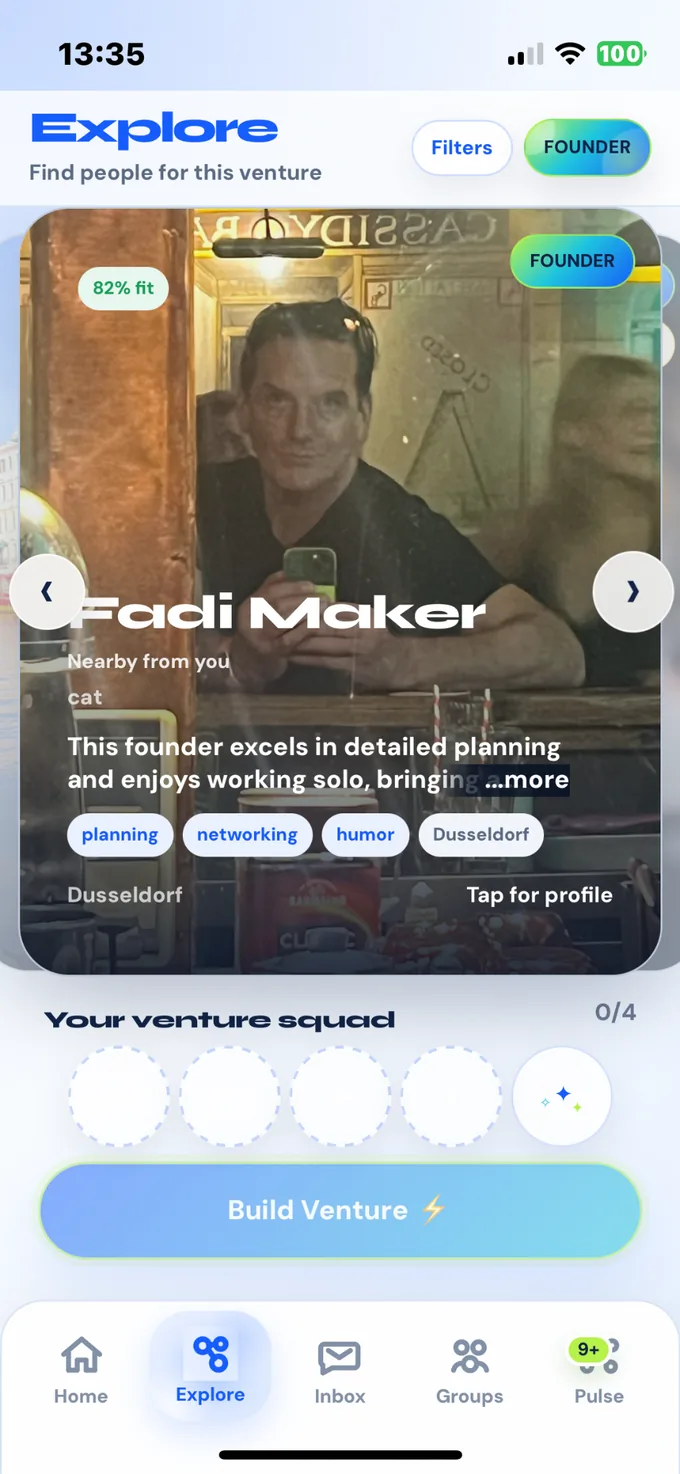
/screenshots; keep the original PNG captures out of the deployed page weight.Three buyers. One product underneath all of them: B2C self-development, B2B employability, and B2B2C entrepreneurial capability / L&D.
Anyone — underemployed or fully employed — looking for connection and future optionality. The volume driver. Free to join, pays to initiate, build, and become more founder-like through practice.
Higher-touch managed partnerships — city programmes, government-backed pilots, universities and alumni networks that want employability, entrepreneurship activation, dashboards and onboarding support.
Same product, same per-seat price as Founder — bought in bulk by an employer or campus as L&D / wellbeing / innovation infrastructure. No walled garden: seat-holders meet the same open pool everyone else does.
A live, cross-checked example of the "why this city" logic every rollout city should pass: young, dense, and with a credible anchor institution — not population size alone.
Every input above is a placeholder assumption for you to replace with real numbers — the point of building this as a live model rather than a static chart is that nobody has to take our word for the output.
Excludes Institution and high-touch Venture-for-campus deals, which are typically negotiated individually and don't fit a per-seat funnel model — see Model for how those are structured instead.
Four tiers. The same usage behaviour can be sold as self-development to individuals, employability to institutions, or entrepreneurial capability to companies.
An employer or campus buys N seats at the standard per-seat price. Employees or students land in the exact same open Kipl everyone else uses — cross-context matching stays intact, which is the whole point per the evidence above. The buyer gets an aggregate, anonymized dashboard showing entrepreneurial behaviour: sessions, squad formation, help requests, badge progression and repeat attendance, rolled up to company or campus level with a minimum cohort size before any stat displays. No individual-level tracking is ever visible to the buyer.
Buyers running "workouts" — internal campaigns to lift entrepreneurial activity across their own population — is a real direction, but a meaningfully bigger feature than the aggregate dashboard: campaign creation, company-scoped prompts, team challenges, leaderboards and its own admin surface. Positioned as a stated v2, not a launch promise.
Two different anchor-customer theses tested first, then contiguous expansion — not cities picked at random.
Tests the pure B2C mechanism — no anchor institution, community-led activation.
Tests the campus-as-Venture-customer thesis — young city, AI-mandatory undergrad cohort.
Contiguous expansion along the M3 — shared ops, shared media spillover from Southampton.
Continuing the corridor toward Greater London, each stop chosen for a credible anchor institution.
Capital density once the corridor model is proven, followed by wider European expansion.
Specific corridor stops (Winchester, Basingstoke, Guildford, Woking) are a proposed, physically contiguous sequence from Southampton toward London — worth confirming or adjusting against real on-the-ground read before this goes in front of anyone.
Some will reduce this to cofounder matching, recruitment, or local hiring. Kipl has to hold the larger frame — social third-place activation, entrepreneurship as the object — through every touchpoint, from onboarding copy to badge labels.
We report session count and retention as the primary KPI, not "ventures launched." That's the evidence-correct choice — Hall's data says attendance is the real lever — but it's a different, less headline-friendly story than a typical startup-matching pitch, and we're choosing it deliberately.
Kipl isn't presenting a formal priced round on this page. The near-term ask is strategic feedback, warm introductions to pilot partners — city programmes, universities, alumni networks, and early corporate L&D / benefits buyers — and early-stage investor perspective on whether a manufactured third place, using entrepreneurship as both the social object and the future-work development layer, is a category worth backing.
Source notes: ONS NEET release, May 2026; ONS Labour Market Overview, June 2026; UK House of Commons Library youth unemployment briefing, May 2026; World Economic Forum Future of Jobs Report 2025; CIPD AI skills / workforce planning research, April 2026; OECD Social Connections and Loneliness in OECD Countries, 2025; University of Southampton, February 2026 announcement; ONS Southampton mid-year population estimates and 2021 Census. Psychological-mechanism citations per the full evidentiary digest, available on request. Draft investor teaser — replace placeholder pricing and model assumptions before external circulation.